The Hidden Security Risk of Shredding High-Density Drives
 21
21 Jan
We need to have a technical conversation about your hard drive shredder. For years, the standard advice for data security was simple. If you wanted to destroy a hard drive, you ran it through a mechanical shredder that chewed it into one-inch strips or chunks. That was considered the gold standard.
That standard is now failing.
The technology of data storage has advanced faster than the technology of data destruction. Manufacturers have achieved incredible feats of engineering, packing terabytes of data into tighter and tighter spaces. Modern high-density helium drives and new glass-platter technologies have fundamentally changed the risk equation.
A standard shredder that was perfectly adequate for a 500-gigabyte drive from 2010 is now a security liability for a 20-terabyte data center drive in 2026.
Why Shredding an SSD is Different Than an HDD
The Physics of Data Density
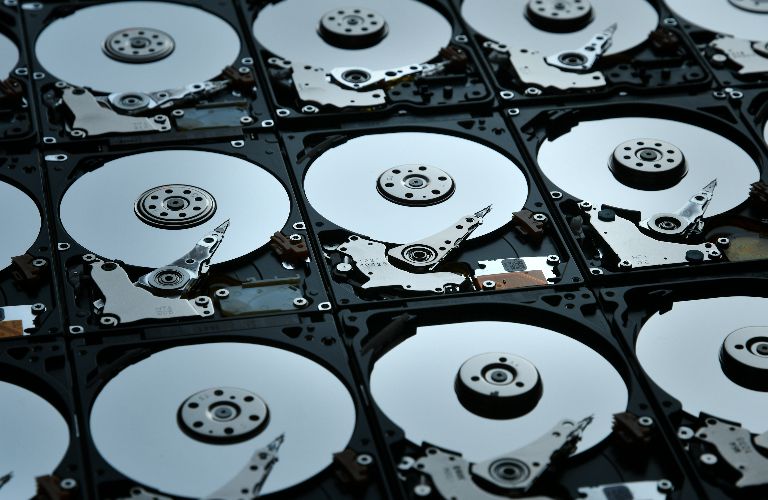 To understand the risk, you have to look at the platter of a hard drive. Data is stored on magnetic tracks. As drives get larger in capacity, those tracks get narrower and more densely packed.
On a modern high-capacity enterprise drive, a single fragment of a platter the size of a fingernail can contain hundreds of gigabytes of data. If your shredder leaves fragments that are one inch wide, you are effectively leaving vast libraries of information intact.
Forensic data recovery has also advanced. Bad actors and state-sponsored hackers have access to sophisticated microscopy and magnetic force scanning tools that can read data from surprisingly small fragments. The margin for error has vanished.
The Helium Problem
Modern high-capacity drives are often sealed and filled with helium to reduce friction. This allows the platters to be thinner and spin closer together.
When you put a helium drive through a standard, low-torque office shredder or an older industrial shredder, it often does not shatter the way an old air-filled drive did. The lightweight, thin platters can sometimes fold or tear rather than disintegrating.
We have seen instances where standard shredders merely bent the drive or left large chunks of the platter fully intact. This is not data destruction. It is merely data mangling. The information is still there for anyone with the resources to extract it.
The New Standard is Micro-Shredding
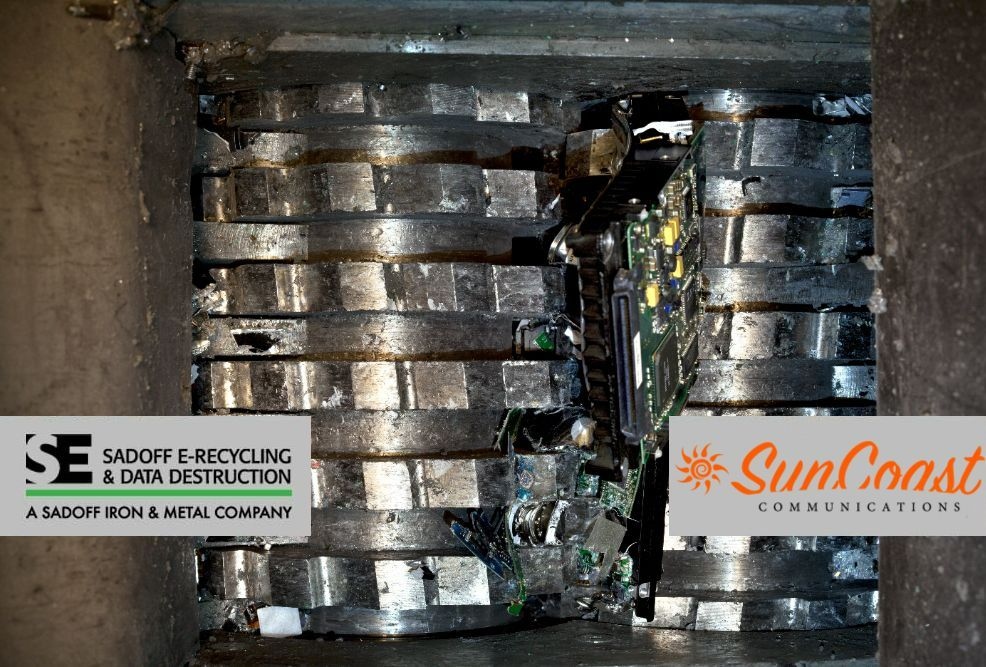
At Sadoff E-Recycling and Data Destruction, we have upgraded our infrastructure to meet this new threat. We do not rely on standard shredding widths for high-density media. We utilize industrial shredders capable of reducing drives to much smaller particle sizes.
For the highest security needs, such as those required by the NSA or for classified data, we go even further. We reduce the drive to a fine residue. At a 2-millimeter particle size, the physical structure of the magnetic track is destroyed. The data is not just inaccessible; it is physically annihilated.
Read More: The Case for Witnessed ITAR Destruction
Verifiable Peace of Mind
You cannot verify what you cannot see. When you hire a mobile shredding truck that does the job in a parking lot, you often do not get to inspect the output. You get a bin of twisted metal and a piece of paper saying it is done.
We operate differently. Our process is designed for auditability. We can provide you with the specifications of our shred size and the assurance that our equipment is calibrated for modern, high-density media.
For clients with extremely sensitive intellectual property or customer data, this attention to detail is not optional. A data breach that originates from a discarded hard drive is the most preventable type of breach. It only happens because of negligence or outdated processes.
Evaluate Your Destruction Vendor
It is time to ask your current destruction vendor difficult questions. Ask them what particle size their shredders produce. Ask them if their equipment is rated for helium-filled enterprise drives. Ask them how they handle solid-state hybrid drives.
If they cannot give you a specific, technical answer, you are using the wrong vendor.
Do not let your physical security fail because your disposal policy is stuck in the past. High-density drives require high-intensity destruction. Contact Sadoff E-Recycling and Data Destruction to ensure your data is gone for good.
Categorized in: Data Security



 Google map directions
 Google map directions
 Google map directions
 Google map directions
 Google map directions
 Google map directions
 Google map directions